

The exhibition ran from 14th to 19th May at Espacio Gallery, Bethnal Green Road, London E2 7DG
Eleven artists explore the concept of Unfolding from their unique perspective. Imaginative interpretations include unfolding drama with 3D characters performing scenarios which leave the viewer guessing; growing-up explored with the artist’s childhood clothes reimagined; family history manifested in fabric design and upholstery, and personal journeys conveyed in stitch.
Some artists have taken unfolding more literally, showing development in their working practice, with exquisite silk shibori, colourful collage, layered materials, printing and applique.
The exhibition is a masterclass in how to bring textiles and mixed media together, showcasing an exciting range of techniques such as embroidery combined with sculpture, bookbinding and paper manipulation, papermaking, quilting, dyeing and using recycled materials.
The group collaborated on two projects, a playful window display depicting personal stories, including a lifetime in shoes, changing fashion, milestones in books and and favourite things.
In a second display the artists have filled a room full of flamboyant and colourful flowers, from bud to full bloom as they unfold in all their glory.
You can scroll to individual artists by clicking on their names here: Kate Beale, Susie Cottee, Rachel Gillard-Jones, Karina Haake, Kathryn Hollingsworth, Ceridwen Sooke, Annika Strandberg, Gill Swanson, Patti Taylor, Veronica Thornton and Yvonne Watts.
And please, feel free to comment at the bottom of this page.
The Gallery Installation
A Life Unfolding
The group collaborated on a playful window display depicting personal stories, including a lifetime in shoes, changing fashion, milestones in books and favourite things, sewn onto individual strips of organdie.


The Darkroom
Kate Beale
Kate’s work is the embodiment of “Unfolding”—her complex art process is made up of the folding and unfolding of silk fabric, compressing and moulding it, boiling and infusing it with colour. At each step in the process, the fabric is unfolded and the colour and shape revealed as something completely new, something unrecognisable as the plain piece of fabric it once was. Her new work continues exploring Shibori dyeing principles, but pushes further with scale and complexity.


Susie Cottee
Susie continues to explore the lifelong unfolding of family stories. The shifting sands of childhood mysteries uncovered, known and understood, somewhat. Deep rooted patterns and themes, repeating through the generations. Susie’s response is a collection of pieces which explore mending, stitching, patching, taking apart, staining, folding, hiding, revealing, unfolding. These pieces are grounded in domesticity: everyday cloths and fibres—inherited, found, repurposed and needed. The stitch is fundamental; it connects and separates. The stitch mends.


Rachel Gillard-Jones
Rachel’s practice is an unfolding narrative of deliberate connection, found through the slow rhythms of fabric manipulation and stitch. Incorporating elements of organic forms found in nature, these soft sculptures act as a means to process challenging circumstances, converting emotional weight into physical structures. Her work often contains hidden objects only known to the artist to increase the connectivity to her process. Rachel navigates the complexities of challenging relationships and circumstances, softening the jagged edges
of the past.


Disentanglement
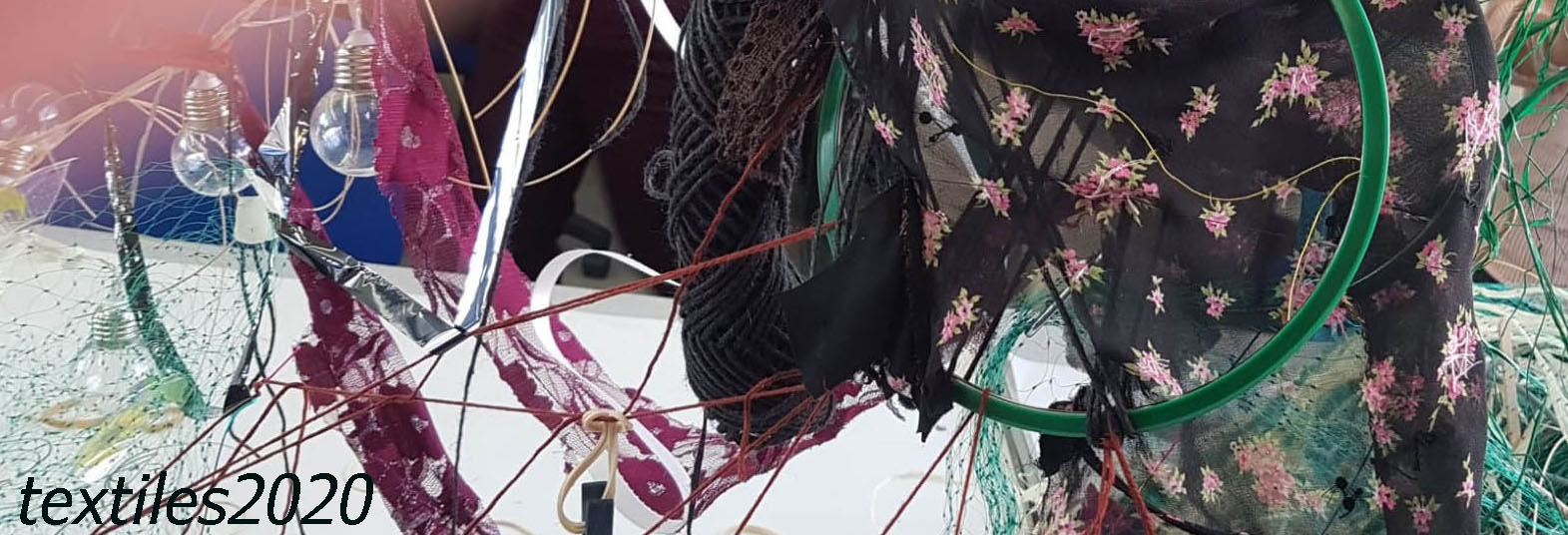
This piece traces a slow emergence of self, using colour and organic forms to mark change, growth and quiet transformation. (Materials used: Repurposed fabrics, wire, rope; assorted threads and buttons.)


Drawing a Veil
This piece centres on an object I kept for years without knowing why, made from the fabric of a dress she wore. Working with it brought back memories and the complexity of our relationship. (Materials used: Vintage object, repurposed fabric, assorted threads and buttons)
Karina Haake
In Unfolding, Karina reflects on migration, memory and the material transformation of her grandmother’s Gustavian armchair that travels through Europe, from Stockholm to West London, in the 1960s. Journeying through homes, landscapes and decades of family life, the fauteuil becomes both witness and metaphor.
Cyanotype made on handmade cotton paper captures the blues of her childhood. Translated onto velvet re-upholstery, it allows the chair itself to carry the blue-layered traces of a story still unfolding.


Armchair with Ears* A Gustavian armchair arrives in London in the 1960s. An immigrant. It accompanies Karina throughout her life, carrying stories and absorbing voices—a witness. Decades later, with handmade paper and cyanotype transposed onto velvet, the armchair is reborn, still listening to the stories that unfold around it.
*Bergère a Oreilles.
Kathryn Hollingsworth
Kathryn’s work explores narrative with a cast of characters performing in unfolding dramas. There is ambiguity and a sense that something has just happened, or is about to happen. The viewer must use their imagination.


The figures are made with a mixture of hand and machine stitched fabric, scraps of lace, and some vintage doll’s clothes.
Kathryn’s inspiration comes from several sources including Paula Rego’s gift for storytelling, and use of dummies and props as models in her work.
Ceridwen Sooke
Ceridwen is fascinated by a wide range and variety of materials as well as processes for making work. She paints papers and fabric which she incorporates into her work alongside plastics, wire, stitch and knitting. She is intrigued by unfolding plant forms, their energy and life force, not always visible to the human eye other than through speeded up film. Microscopic details of seeds are equally interesting as these tiny forms unfold. Her work seeks to express this energy.


The collages begin as drawings based on the huge variety of plant forms, their colour, size and textures as they unfold. Tissue papers are painted with acrylic inks. Some papers are folded before painting to create subtle organic marks. The papers are then layered to create rich depth of colours.


The small collages are made with a variety of materials. Fabrics, hand painted papers, plastics, wire and stitch are used. The collages develop from a starting point with no clear idea of how they will end up. They offer semi abstract images loosely based on organic forms.
Annika Strandberg
Objects look different depending on light, distance, and angle. In these pieces, Annika has been experimenting with how images unfold and reveal themselves depending on how much light there is, where it hits the artwork, and how the distance to it affects your experience and impression.
She has been working with a weaving pattern called Monk’s Belt, combining it in different ways.


A piece of cloth can look so different depending on light, whether the viewer stands close or far away and what is hanging nearby. The main objective in this work is to explore the pattern Monk’s belt. Different effects are achieved by lifting the loom’s shafts in different combinations and the direction of light.
Gill Swanson
Gill enjoys creating artwork with vibrant colours and varying textures. She likes to work in an intuitive way, randomly putting pieces together, then layering them, cutting them up and switching the shapes around until happy with the result. Much of her work is joined together by using free motion stitching and dissolvable fabric. Once dissolved, interesting structures and textures evolve with the fabrics unfolding in different ways. Recently Gill has been dying fabrics and has introduced these into her work.


These richly textured textile works combine dyed and embellished fabrics including linen, silk, organza, muslin and denim with felting wool, beads and stitched netting effects. Using free motion stitching, dissolvable fabric and layered construction, the pieces explore depth, contrast, fragility and structure through intricate surfaces, suspended forms and densely worked tactile detail.
Patti Taylor
As life unfolds, neither language nor memory holds steady. Patti’s Sensarium gathers unnamed sensations, proposing words for what slips past articulation and remains difficult to share. Map of Memory charts a shifting terrain of lived experience, marked by regret, shame, hurt, and lost love. Cuts, folds, and gaps reveal distortion and loss. Together, the works hold what cannot be fully spoken or retrieved, where feeling and recollection blur, and meaning remains unresolved and in flux.


Map of Memory Two representations of the same idea: places from memory are collaged onto a rusted, fading cloth, just as memories fade and distort; cuts and folds disrupt memory; shifting place names trace regret, shame, hurt, and loss. Hidden histories fold into the small box. In both versions, feelings are hidden.


Sensarium: As life unfolds, language falters; these stitched works invent words for overlooked emotions, holding fleeting sensations in cloth, thread, and quiet attention. Handstitched on cotton.
Veronica Thornton
The pieces in the exhibition are inspired by unpacking an attic trunk containing clothes and textiles kept by Veronica’s mother. Unfolding the items began the unfolding of memories: the first house lived in, infinity mirrors from her nana’s dressing table and preserved baby clothes.
Veronica’s response reflects the make-do-and-mend attitude following WW2, as in the remnants of Czechoslovakian silk ties used to make a cot cover. Old fabrics have been used throughout the work in recollection of a post-war period.


The work results from opening a trunk stored in the attic containing clothes and fabrics from my childhood kept by my mother. Unpacking and unfolding these items also unfolded early memories of specific places and events. Fabric collages are created combining garments and vintage fabrics to evoke feelings of post war England.
Yvonne Watts
Yvonne draws her inspiration from the unfolding shapes, colours and textures of a wide variety of foliage.
Visiting local parks and nature spaces to draw and paint from direct observation, she then adds imagined colours and plant combinations by printing onto silk using polychromatic dye, a process that creates unpredictable textures and marks.
She also adds applique and machine stitch with scraps of hand dyed silk to achieve highly colourful compositions.


Leave a Comment: